Updated March 24, 2026 · By Jake Embers
Best Pizza Stones and Ovens for Grills



Best Pizza Stones and Ovens for Grills
I ruined four pizzas before I accepted that my grill setup needed help. My Weber Spirit runs about 550°F max with the lid down - respectable for steaks, completely inadequate for Neapolitan pizza. The crust would cook through eventually but never get that char-spotted bottom and leopard-print edge that makes wood-fired pizza worth eating. I'd read enough about high-heat pizza to know the problem: I needed 800°F minimum, preferably 900°F+, and I needed a surface that would transfer that heat to the dough fast.
That sent me down a rabbit hole of pizza stones, grill inserts, and dedicated outdoor ovens. I've cooked on stones in charcoal setups, on ceramic in gas grills, with a KettlePizza insert that turned my Weber into something closer to a pizza oven, and on the Ooni Koda that genuinely changed how I think about outdoor pizza. The results varied wildly - not just in crust quality but in how much setup work each method required and how forgiving it was for a beginner.
What follows is an honest ranking of the five best options across the full price spectrum. Whether you want to spend $27 or $399, there's a setup here that will produce pizza better than anything you've been getting from your bare grill grates.
Quick Answer
Top Pick: Ooni Koda 12 Gas Pizza Oven at $399 - if you're serious about outdoor pizza, nothing else on this list comes close to the results it produces.
Budget Pick: Cordierite Pizza Stone 15x12" at $30 - the best value stone for grill or oven use, with four handles and genuine crack resistance.
Our Top Picks
| Product | Best For | Price | Rating |
|---|---|---|---|
| Ooni Koda 12 Gas Pizza Oven | Serious pizza enthusiasts, Neapolitan style | $398.95 | 4.4/5 ★★★★½ |
| KettlePizza Basic Oven Kit | Weber kettle owners, wood-fired flavor | $155.00 | 4.3/5 ★★★★☆ |
| Weber Crafted Pizza Stone | Weber Genesis/Spirit grill owners | $54.99 | 4.4/5 ★★★★½ |
| Cordierite Pizza Stone 15x12" | Any grill or oven, best value | $29.97 | 4.4/5 ★★★★½ |
| Round Pizza Stone 12.6" | Solo cooking, smaller pizzas | $26.96 | 4.4/5 ★★★★½ |
1. Ooni Koda 12 Gas Pizza Oven

I'll be straight with you: the Ooni Koda 12 is not a grill accessory. It's a standalone gas-powered pizza oven that happens to live outdoors next to your grill. I'm including it here because if you want to actually cook Neapolitan pizza - the kind with a charred, blistered, chewy crust and a soft center - nothing else on this list will get you there. Your grill maxes out around 550°F. The Ooni Koda reaches 950°F. That difference is everything.
At 950°F, a 12" pizza cooks in 60 seconds.
The first time you use it, you'll almost certainly burn one - I burned my first three. The margin between perfectly charred and carbonized at that temperature is about 20 seconds, and you need to rotate the pizza every 15-20 seconds to avoid scorching one side. But once you get the rhythm, the results are legitimately extraordinary. The crust develops the kind of bottom char and airy interior structure that takes most wood-fired restaurant ovens. The 12" cordierite stone inside reaches temperature in about 15 minutes on a propane setup.
The Ooni is the right purchase for someone who genuinely wants outdoor pizza to be a recurring thing. If you're going to make it five or more times this summer, the $398.95 pays for itself in saved delivery costs and far better results. If you just want to try grilled pizza once, start with one of the stone options below. For a deep dive into dough, sauce, and technique, our grilled pizza recipe walks through everything including the right hydration level for high-heat cooking.
What I Like:
- 950°F maximum temperature - genuinely Neapolitan-capable
- 60-second cook time once you're in the groove
- Propane setup is clean, consistent, and easy to control
- 15-minute preheat - faster than a traditional oven
- Compact footprint for a dedicated pizza oven
What I Don't:
- $398.95 is real money for a single-purpose appliance
- 12" diameter limits you to personal-sized pizzas only
- Learning curve is steep - expect to burn 2-3 before finding your rhythm
- Requires a propane connection separate from your grill
Who it's for: Anyone who wants to cook restaurant-quality Neapolitan pizza at home and is willing to invest in the right tool to do it.
2. KettlePizza Basic Oven Kit

The KettlePizza solves a real problem: you have a 26.75" Weber kettle with excellent temperature control and wood/charcoal capability, and you want to use it for pizza without buying a whole separate appliance. The kit inserts between the kettle body and the lid, creating a front opening through which you slide and rotate the pizza. It's clever, and it works better than I expected.
The key to the KettlePizza is understanding what it does to your airflow. By raising the lid and creating that front opening, it allows you to build a much hotter fire toward the back while the opening draws in fresh air. With a full chimney of hardwood lump charcoal and some oak chunks, I've gotten my kettle to 750°F+ on the stone surface - not quite Ooni territory but well above what a covered kettle can sustain. The wood smoke component is the real differentiator here: you get flavor notes that a gas oven simply can't match.
The 4.1/5 rating reflects a genuine limitation: the KettlePizza requires practice, and temperature management on a charcoal fire is less precise than gas.
Your first few pizzas will probably be uneven - charred on the back, underdone on the front, because the fire is asymmetric. Once you learn to rotate aggressively every 20 seconds it becomes manageable. This is the option for someone who already loves their Weber kettle, wants the wood-smoke flavor in their pizza, and is willing to put in the learning time. If you're exploring charcoal techniques beyond pizza, our competition-style smoked ribs guide covers fire management that transfers to high-heat cooking.
What I Like:
- Turns your existing Weber kettle into a functional pizza oven
- Wood/charcoal capability adds genuine smoke flavor
- Can reach 700-750°F with proper fire management
- Fits 26.75" Weber kettle - the most common serious charcoal grill
- More versatile than a dedicated gas pizza oven
What I Don't:
- Temperature management is imprecise compared to gas
- Uneven heat distribution requires constant pizza rotation
- Charcoal/wood adds prep and cleanup time
- 4.1/5 reflects a real learning curve that not everyone will push through
Who it's for: Weber kettle owners who want wood-fired pizza flavor and are willing to master charcoal fire management to get it.
3. Weber Crafted Pizza Stone

If you own a Weber Genesis or Spirit with the Crafted frame system, this is the most integrated pizza stone option available. The Weber Crafted Pizza Stone seats into the Crafted frame without any improvised setup, and it heats evenly across the surface because it's in direct contact with the burners in the way Weber engineered for their grill. That engineering matters - a stone that's placed haphazardly on grill grates has hot spots and cool edges. This one doesn't.
The glazed surface is easier to clean than raw cordierite, which absorbs grease and oils over time and can develop off-flavors. You can wipe the Weber Crafted stone down after cooking rather than just scraping it, which is a quality-of-life improvement that matters if you're making pizza regularly. The stone gets to cooking temperature in about 15-20 minutes with the Genesis or Spirit at high heat - I measured around 600°F on the stone surface, which won't give you 60-second Neapolitan but will give you excellent crispy-bottom pizza in 8-10 minutes.
At $54.99 it's the most expensive stone-only option here, and the Crafted frame requirement means it's not universal.
But for Weber gas grill owners who want seamless integration and easy cleanup, it's the right call. I made a grilled pizza recipe using this exact stone and the results were the best I've achieved on a standard gas grill. Skip this if you don't own a Weber Crafted system - it won't fit properly on other grills.
What I Like:
- Designed for Weber Crafted frame - perfect integration with Genesis/Spirit
- Glazed surface cleans up much easier than raw cordierite
- Even heat distribution because it seats properly in the frame
- Reaches 600°F on a Weber gas grill
- Weber quality and warranty backing
What I Don't:
- $54.99 for a stone is a premium price
- Requires the Weber Crafted frame system - not compatible with other grills
- 600°F ceiling means no true Neapolitan-style results
Who it's for: Weber Genesis or Spirit owners with the Crafted frame who want a seamlessly integrated pizza stone with easy cleanup.
4. Cordierite Pizza Stone 15x12"

Cordierite is the material most professional pizza ovens use for their baking surfaces, and this rectangular 15x12" stone brings that material to your grill or oven at $29.97. The shape is actually a meaningful advantage over round stones - you can fit a 12" round pizza with room to maneuver the peel, or you can bake a rectangular flatbread or focaccia directly on the surface. The four built-in handles mean you can move this stone safely even when it's been sitting in a 500°F grill for an hour.
The crack resistance is worth dwelling on. Cordierite has a lower thermal expansion coefficient than most ceramics, which means it handles rapid temperature changes without cracking. I've gone from room temperature directly onto a 550°F grill without any issues - something that would destroy a cheap ceramic stone. I've also had it through a couple of thermal shocks from accidentally getting water on it during cleanup (not recommended, but it survived). The double-faced design means when one side gets stained from cheese and oil, you can flip it.
For the price, this is the most practical all-around stone on the list.
It works in your oven for weeknight pizza, on your gas grill for weekend grilling sessions, and even on a charcoal grill if you can control the temperature. The four handles make it genuinely portable rather than a fixed installation. This stone pairs perfectly with our grilled vegetables guide - once the pizza's done, the residual heat cooks vegetables beautifully.
What I Like:
- Genuine cordierite - the same material used in professional ovens
- Crack-resistant through real thermal stress testing
- Four handles make it safe and portable at temperature
- Rectangular shape handles more pizza sizes than a round stone
- Works in oven, gas grill, charcoal grill - truly versatile
- Excellent price at $29.97
What I Don't:
- Absorbs oils over time - requires careful cleaning to avoid off-flavors
- At 15x12", it's large enough to take up significant grill grate real estate
- No visual indicator of when it's at temperature - need a thermometer
Who it's for: Anyone who wants a high-quality, versatile pizza stone for both oven and grill use without spending more than $30.
5. Round Pizza Stone 12.6"
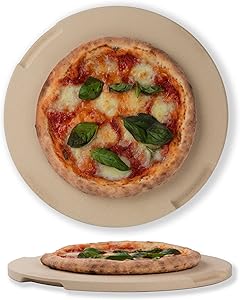
The 12.6" round stone is the simplest entry point on this list - a double-faced cordierite stone at $26.96 that handles personal-sized pizzas in any heat source. The built-in handles and double-faced design match what the larger rectangular stone offers, scaled down for a smaller footprint. If you're cooking for one or two people, a 12" pizza is the right size and this stone fits that use case perfectly.
The round shape is more natural for most home pizza makers since we're used to shaping dough into rounds. There's less wasted surface area around the edges compared to fitting a round pizza on a rectangular stone. The 12.6" diameter gives you just enough clearance around a 12" pizza to get a peel underneath without knocking the crust off the edge - a tighter fit than the rectangular stone, but manageable.
At $26.96 this is the least expensive stone on the list. The double-faced design extends its usable life since you can rotate surfaces when one side gets heavily stained. It's compatible with gas grills, charcoal grills, and conventional ovens, making it genuinely useful even if your grill situation changes. For a solo cook or a couple who wants to explore grilled pizza without committing to a larger setup, this is the obvious starting point.
What I Like:
- $26.96 makes it the most accessible stone on the list
- Round shape matches natural pizza dough shaping
- Double-faced design doubles usable surface life
- Built-in handles for safe transport at temperature
- Works in oven, gas grill, and BBQ
What I Don't:
- 12.6" limits you to personal-sized pizzas
- Smaller stones heat less evenly on large grill grates with wide burner spacing
- Round shape means fewer alternative uses (no flatbreads, no rectangular bakes)
Who it's for: Solo cooks and couples who want to try grilled pizza without a big investment - a reliable first stone at a fair price.
Who Should Skip This
If you're only going to make pizza twice a year, don't buy any of this gear. Seriously. The learning curve on grill pizza technique means your first few attempts will be mediocre regardless of equipment, and infrequent use means you'll never develop the muscle memory that makes the process smooth. Order from your local pizzeria instead.
Also skip this if you can't preheat for 30-45 minutes. Every stone on this list requires genuine preheating time to build thermal mass - there's no shortcut. If you want 15-minute start-to-finish pizza, stick with your oven and a frozen pie.
What Mattered Most
The single most important factor in outdoor pizza quality is surface temperature, and this is where most grillers go wrong. They put a stone on the grill, let it preheat for five minutes, and wonder why the bottom is pale and chewy. A cordierite stone needs 30-45 minutes to fully absorb heat through its thickness - the surface may measure 500°F while the interior is still 300°F, and that thermal mass is what transfers heat to your dough in the first 60-90 seconds. I now preheat every stone for at least 30 minutes before launching the first pizza.
Dough hydration matters more than most guides admit.
High-heat pizza requires dough with at least 65% hydration - lower hydration doughs cook too fast on the outside before the inside has time to develop. If your pizza is coming out with a pale interior and dark bottom, your hydration is too low. I've settled on 68% hydration for most grill pizza, which is sticky to handle but produces the right interior structure. Our whole smoked chicken recipe uses similar hydration principles for the skin to get crispy results.
Equipment interaction was a recurring surprise in testing. The Weber Crafted stone behaved completely differently on a Genesis versus a Spirit because the burner layout is different - even within the same product ecosystem, surface temperature varied by 80°F depending on which grill I used it with. The universal stones (cordierite options) were more predictable across different setups because I could control their placement manually. Model-specific accessories are convenient but they're also dependent on a specific grill's heat distribution.
The peel technique took me longer to master than any other variable. Launching a pizza from a wooden peel onto a 550°F stone requires confidence - hesitation lets the dough stick and fold over itself. I now use a dusting of semolina flour on the peel rather than regular flour, which creates tiny ball bearings under the dough and makes the launch dramatically more reliable. For more detailed guidance on outdoor cooking fundamentals, check our smoking times and temperatures cheat sheet.
FAQs
Do I need a dedicated pizza oven or can I use my regular grill?
You can make great pizza on a regular gas or charcoal grill with a good stone, but there are real limitations. Most gas grills max out around 500-600°F, which produces good crispy-bottom pizza but not Neapolitan-style results. If you want 60-second pizza with a blistered, charred crust, you need something that reaches 800-950°F - that means either the Ooni Koda or the KettlePizza with an aggressive charcoal fire. For everything else, a good cordierite stone on your existing grill gets you surprisingly far.
How do I prevent pizza from sticking to the stone?
Preheat the stone fully (30-45 minutes), use semolina flour instead of regular flour on your peel, and make sure the dough isn't too wet on the bottom before launching. Semolina is coarser than regular flour and creates a non-stick layer between the dough and peel. Also avoid putting toppings on the pizza while it's still on the peel - the moisture from sauce soaks into the dough and causes sticking. Build the pizza on the peel quickly and launch immediately.
Can I use a pizza stone on a charcoal grill?
Yes, and charcoal can actually produce better results than gas because you can get the stone hotter and you have the option of adding wood chunks for smoke flavor. Place the stone on the grate with all coals banked to one side or around the perimeter - not directly under the stone. Let it preheat for 30-45 minutes with the lid on. The KettlePizza kit formalizes this approach for Weber kettles, but any cordierite stone will work in a standard charcoal grill setup.
How do I clean a pizza stone?
Let it cool completely before touching it - thermal shock from water on a hot stone can crack it. Scrape off any debris with a bench scraper or stiff brush. Avoid soap, which absorbs into the porous cordierite and creates off-flavors. For stubborn cheese or sauce stains, a paste of baking soda and water applied and then scraped off works better than any commercial cleaner. Staining is inevitable with cordierite - it's normal and doesn't affect performance.
What size pizza stone do I need?
Match the stone size to your grill grate and your typical pizza size. A 15x12" rectangular stone is the most versatile for most gas grills - it gives you room to maneuver a peel and covers the grate area efficiently. For charcoal grills or smaller gas grills, a 12.6" round stone fits more easily and still handles a standard personal pizza. Don't go too large - a stone that extends past your grill's burners will have cool edges and heat unevenly.
Get Weekly BBQ Tips from Jake
No spam. Just one email a week with grilling tips, recipes, and gear deals.
Products Mentioned