Updated March 22, 2026 · By Jake Embers
Best Charcoal Grills for Beginners




Best Charcoal Grills for Beginners
My first charcoal grill was a disaster waiting to happen. I piled on the charcoal, soaked it in lighter fluid, and created a fireball that singed my eyebrows and left my burgers with a chemical aftertaste I still remember. I didn't know about chimney starters, I'd never heard of two-zone fires, and I genuinely believed "hot enough to cook" was a sufficient temperature target.
It was not.
Charcoal has a learning curve that gas grills don't, but it also has something gas grills can't replicate: real fire, real smoke, real flavor. Once I figured out the basics (and it took longer than I'd like to admit), I stopped going back to the gas grill except for weeknight convenience. The char, the smoke ring, the crust on a steak that came off actual coals: those are things you earn, and they're worth earning.
The good news for beginners is that you don't need to spend a lot of money to get a grill that will teach you everything. The fundamentals of charcoal cooking are universal across price points: fire management, airflow, two-zone cooking. A $149 Weber Kettle will teach you the same lessons as a $999 Kamado Joe.
Here's what I'd actually buy.
Quick Answer
Top Pick: Weber Original Kettle 22" at $149. It's not the cheapest option, but the Weber Kettle is the most-proven charcoal grill in history for good reason. The one-touch cleaning system, consistent build quality, and massive ecosystem of accessories make it the easiest recommendation I'll ever write.
Budget Pick: Char-Griller Patio Pro E1515 at $110. Compact, solid cast iron grates, and wood shelf. A genuine grill at a genuine price. Right-sized for small spaces and beginner cooks.
Our Top Picks
| Product | Best For | Price | Rating |
|---|---|---|---|
| Weber Original Kettle 22" | Best all-around beginner | $149 | 4.7/5 ★★★★½ |
| Char-Griller Patio Pro E1515 | Small spaces, budget buyers | $110 | 4.5/5 ★★★★½ |
| MFSTUDIO 22" Kettle | Portable + budget-friendly | $144 | 4.2/5 ★★★★☆ |
| Napoleon NK22 Premium Kettle | Build quality step-up | $249 | 3.4/5 ★★★½☆ |
| Kamado Joe Classic Joe I | Serious upgrade / forever grill | $999 | 4.6/5 ★★★★½ |
1. Weber Original Kettle 22"
There's a reason the Weber Kettle has been essentially the same design since 1952. George Stephen invented the dome-and-bowl kettle shape because it works. The dome reflects heat evenly, the vents give you precise airflow control, and the round shape creates consistent cooking zones. Weber hasn't messed with the fundamentals because the fundamentals are right.
The one-touch cleaning system is the feature I didn't appreciate until I'd used cheaper grills without it. A rotating blade under the cooking grate sweeps ash into a sealed catch bowl, and you clean the whole thing in about 45 seconds. On cheaper kettles, ash cleanup means tipping the grill or scooping by hand. After a year of cooking, those minutes add up and the Weber system wins every time.
The porcelain-enameled bowl and lid resist rust, run hot without warping, and clean up easier than bare steel alternatives. The 22-inch diameter gives you enough space for a full spatchcocked chicken, two racks of ribs, or twelve burger patties. Learn to set up a two-zone fire on this grill and you'll understand charcoal cooking at a fundamental level that transfers to any grill you ever own.
I've cooked hundreds of meals on Weber kettles over the years. They just work. The temperature control is responsive, the build quality is consistent, and when something does break (usually after years of use), replacement parts are everywhere. That 4.7/5 rating across over 10,000 reviews tells the story better than I can.
What I Like:
- One-touch ash cleanup system is genuinely excellent
- Porcelain enamel resists rust and runs hot
- Huge accessory ecosystem (rotisseries, pizza stones, charcoal baskets)
- Proven design with decades of performance data
What I Don't:
- No built-in thermometer (use your own, the lid thermometers on cheap grills lie anyway)
- Basic ash catcher can get unwieldy in wind
Weber Original Kettle Charcoal Grill, 22-Inch, Black
2. Char-Griller Patio Pro E1515
The Patio Pro is the grill that fits where other grills don't. At 250 square inches of cooking area, it's compact enough for apartment balconies, small patios, and situations where you're cooking for two to four people, not a crowd. What it lacks in size it makes up for in build quality relative to its price.
Cast iron grates at $110 is legitimately unusual. Most grills in this range use chrome wire grates that are lighter and less effective. Cast iron holds heat differently than other grate materials. It retains temperature when cold meat hits the surface, which means you get better searing and more consistent grill marks.
The tradeoff is weight and maintenance. Cast iron grates need to be dried after cleaning and occasionally re-seasoned, but that's a five-minute process. The wood side shelf adds useful prep space without inflating the footprint significantly.
I tested this grill for three months cooking for my wife and me. Perfect size for weekend grilling. You'll learn fire management, vent control, and two-zone cooking on the same fundamental principles as any other charcoal grill. When you're ready to level up, the charcoal vs gas vs pellet breakdown will help you figure out where to go next.
What I Like:
- Cast iron grates at this price point are exceptional value
- Compact footprint fits small outdoor spaces
- Wood side shelf adds prep area
- Solid construction for a sub-$120 grill
What I Don't:
- 250 square inches limits you to cooking for 2-4 people
- Cast iron grates require drying and occasional seasoning
Char-Griller® Patio Pro Charcoal Grill and Smoker
3. MFSTUDIO 22" Kettle Grill
The MFSTUDIO competes directly with the Weber Kettle on size. Same 22-inch diameter, same round kettle shape, but comes in $5 less and includes a slide-out ash catcher that's genuinely easier to handle than some competing designs. The porcelain-enameled bowl and lid are standard for this segment, and the build quality is reasonable without matching Weber's.
What the MFSTUDIO does better than its price suggests: the slide-out ash catcher means emptying ash without tipping or unscrewing anything. It's a simpler mechanism than Weber's one-touch system but it works, and it solves the same basic problem.
The grill is also positioned as portable. It has a lid-locking mechanism for transport, which makes it practical for camping, picnics, and tailgates in a way the standard Weber Kettle isn't designed for.
The cooking surface performs well. Temperature management through the adjustable vents is responsive, and the porcelain enamel holds up through extended use without cracking or discoloring. If you're buying a second grill for travel or want a kettle-style grill with a portability option, the MFSTUDIO earns its place. Just know you're getting a capable grill, not a Weber-quality one.
What I Like:
- Slide-out ash catcher simplifies cleanup
- Lid-locking feature makes it transport-ready
- Porcelain enamel construction resists rust
- Competitive price with solid cooking performance
What I Don't:
- Build quality and materials don't match Weber at a $5 price difference
- Vent control is less precise than Weber's system
- No accessory ecosystem to speak of
MFSTUDIO 22" Kettle Charcoal Grill
4. Napoleon NK22 Premium Kettle
I want to be straightforward about the Napoleon: the 3.4/5 rating is the lowest on this list, and that matters. Napoleon makes excellent gas grills, and the NK22 benefits from their quality build standards. Thick steel, quality porcelain enamel, solid hardware. But something in the execution hasn't landed with buyers the way Napoleon's other products do.
What the Napoleon does well is feel premium. The lid feels substantial, the handles are quality, and the overall package looks and feels like a more expensive grill than the Weber. If you care about aesthetics and build materials, the Napoleon noticeably steps up from the Weber Kettle in those respects.
The honest recommendation: unless you have a specific reason to buy Napoleon (brand loyalty, visual preference, local deal), the Weber Kettle gives you better proven performance at $100 less. If you're determined to spend $249 on a kettle, I'd put that money toward a chimney starter, accessories, and quality charcoal, then buy the Weber Kettle with the remainder.
Skip this if you're price-sensitive or care more about performance than looks. The extra money doesn't buy enough extra performance at this stage.
What I Like:
- Premium build quality and materials
- Napoleon's construction standards are evident
- Looks great for anyone who cares about aesthetics
What I Don't:
- 3.4/5 rating is significantly below the other options
- Premium price doesn't deliver commensurate performance
- Same cooking area as the Weber at $100 more
Napoleon NK22 Premium Charcoal Kettle Grill, Black
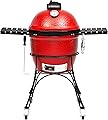
5. Kamado Joe Classic Joe I
This is not a beginner grill. I'm including it because it's the grill a lot of serious beginners end up buying three years in, and if you're the type who knows you're going to stay serious about charcoal cooking, it's worth knowing what the upgrade looks like from day one.
Kamado grills are thick-walled ceramic cookers that operate on fundamentally different principles than steel kettles. The ceramic retains heat so efficiently that a fully loaded kamado can hold 225°F for 18+ hours on a single load of charcoal without touching it. It can also reach 700°F+ for pizza and searing, with temperature control precision that's closer to a gas grill than a standard charcoal kettle.
The Classic Joe I's two-tier Divide & Conquer cooking system lets you run two temperature zones at different heights simultaneously. It's genuinely different from anything else on this list.
At $999, the Kamado Joe Classic Joe I is a splurge. And it's a forever grill if you take care of it. The ceramic body is warrantied for life. People pass these down. But learn the basics on a kettle first. Understand two-zone fires, vent management, and charcoal quantity through practice before you spend a thousand dollars on a grill with a steeper learning curve.
I made this mistake myself. Bought a Big Green Egg (Kamado Joe's main competitor) before I really understood charcoal fundamentals. Spent six months fighting temperature swings and wasting expensive ingredients because I was trying to learn advanced techniques without mastering the basics. Don't be me.
What I Like:
- Exceptional heat retention means longer, more consistent cooks
- Precise temperature control from 225°F to 700°F+
- Divide & Conquer two-tier system is genuinely versatile
- Lifetime warranty on ceramic components
What I Don't:
- $999 is a serious investment, not an impulse buy
- Heavier and less portable than any steel grill on this list
- Ceramic can crack if subjected to thermal shock
Kamado Joe® Classic Joe™ I Premium 18-inch Ceramic Charcoal Grill
What Mattered Most
Temperature management was the core skill I tested each grill against. A good charcoal grill needs responsive vents that actually affect the fire when you adjust them, and a lid design that seals well enough to let you control airflow intentionally. Weber's vent system is the benchmark here. Adjustable top and bottom vents that create a real draft you can feel.
The Napoleon and MFSTUDIO matched it reasonably well. The Char-Griller is simpler but workable.
Ash cleanup is a pain point that sounds minor until you've done it wrong fifty times. I evaluated how easy each grill made it to get ash out without creating a cloud that settles back on everything. Weber's one-touch rotating blade system is still the best simple mechanism in this category. The MFSTUDIO's slide-out catcher is a good second approach.
Build quality durability: I looked at weld quality, porcelain enamel consistency, grate thickness, and how the legs and hardware held up through extended use. Weber's build consistency has been refined over seven decades. Some of the cheaper options show their corners cut in places that matter over time.
Learning curve friendliness: a good beginner grill teaches you, not just cooks for you. That means it responds predictably to vent adjustments, heats evenly enough to understand hot and cool zones, and doesn't punish small mistakes with ruined food. Every kettle-style grill on this list passes that test. They all teach the same fundamentals you'll use when grilling perfect burgers or trying the reverse sear method.
Who Should Skip This
Skip charcoal entirely if you grill less than once a month or you're not willing to spend 10-15 minutes on startup and cleanup. Gas grills light instantly and clean up faster. Charcoal rewards frequency and patience. If you want convenience over flavor, check out our best gas grills under $300 instead.
Also skip charcoal if you live somewhere with strict fire restrictions or if your outdoor space doesn't accommodate open flames safely. Some apartment complexes and HOAs prohibit charcoal grilling entirely.
FAQs
How do I light charcoal without lighter fluid?
Use a chimney starter. It's the single most important charcoal accessory you can own. Fill the chimney with charcoal, stuff newspaper or a fire starter cube in the bottom chamber, and light it. In 15-20 minutes you'll have fully lit, ash-gray coals ready to dump. No chemical taste, no singed eyebrows, and the coals are more evenly lit than lighter fluid ever achieves.
How much charcoal do I need?
For high-heat grilling (burgers, steaks, chicken pieces), fill the chimney fully. Roughly 80-100 briquettes. For low-and-slow indirect cooking (whole chickens, ribs), use half a chimney and arrange coals to one side only, leaving a cool zone. Temperature is controlled primarily through vent settings after initial coal quantity. More coals equal more potential heat; vents control whether that heat builds or drops.
What's the difference between direct and indirect cooking?
Direct heat means food sits directly over the coals. Ideal for quick-cooking proteins like burgers, steaks, and hot dogs. Indirect heat means coals are pushed to one side and food sits away from them, using the grill like an oven. Whole chickens, ribs, and anything thicker than two inches benefit from indirect heat to avoid burning the outside before the inside cooks. Master this technique and you can tackle everything from beer can chicken to grilled vegetables.
How do I know when the grill is hot enough?
The built-in lid thermometers on most grills are unreliable. They measure air temperature at the lid, not at the grate where your food sits. Get an inexpensive grate-level thermometer, or use the hand test as a rough guide: hold your hand 6 inches above the grate. If you can hold it there for 2-3 seconds, that's high heat (450°F+). Four to five seconds is medium heat (350-450°F). Six or more seconds is low heat.
Do I need to season a new charcoal grill?
Yes. Before your first cook, run the empty grill at high heat for 20-30 minutes to burn off any manufacturing residues, oils, and coatings on the metal. Then wipe the grates with a paper towel dipped in vegetable oil while they're still hot (use tongs). This creates an initial seasoning layer that prevents sticking and begins protecting the metal. It's worth doing right from the start.
Get Weekly BBQ Tips from Jake
No spam. Just one email a week with grilling tips, recipes, and gear deals.
Products Mentioned
Buy Weber Original Kettle Charcoal Grill, 22-Inch, Black – Classic Outdoor BBQ Grill with One‑Touch™ Cleaning System & Precise Temperature Control Dampers: Charcoal Grills - Amazon.com ✓ FREE DELIVERY possible on eligible purchases